Every September, Isla Vista resets. Leases turn over on the first, moving trucks line Del Playa and Sabado Tarde for a week, and a new set of tenants moves in just ahead of UC Santa Barbara's fall quarter. We've worked rental properties and small apartment buildings throughout Isla Vista for more than two decades, and turnover season reliably produces more plumbing calls than any other stretch of the year. Almost none of it is bad luck. It's the predictable result of pipe that was sized and installed for a very different pattern of use than the one it's actually carrying now.
Isla Vista is one of the most densely occupied square miles on the Central Coast, packed almost entirely with rental units serving UCSB students, and that density is exactly what makes its plumbing behave differently than a comparable single-family home a few miles away in Goleta or up the coast in Ventura. Here's what we actually see when we're called out to I.V. properties, why the housing stock itself is most of the story, and what property owners and managers can do to stop paying for the same failure every fall.
Built for a Different Occupancy Than It's Carrying
Most of Isla Vista's rental stock went up between the mid-1960s and early 1980s, during UCSB's fastest growth years, which puts a large share of it at 45 to 60 years old today. That era of construction used materials that were standard at the time and reasonable for the occupancy assumptions of that time: 2-inch and 3-inch cast iron for building drains, galvanized steel supply lines in a lot of the older buildings, and 30- to 40-gallon tank water heaters sized for a household of three or four.
The California Plumbing Code sizes drain piping using drainage fixture unit tables, which assign an expected load to each fixture and size the pipe to carry the total for the occupancy the building was designed around. What actually happens in a lot of I.V. rentals is a two-bedroom unit built for a small family now houses four to six tenants, each running a full bathroom routine on a compressed morning schedule before an 8 a.m. lecture. The pipe wasn't undersized when it went in. It's carrying two to three times the daily cycles it was ever expected to handle, and that accelerates every failure mode the pipe was already going to have eventually.
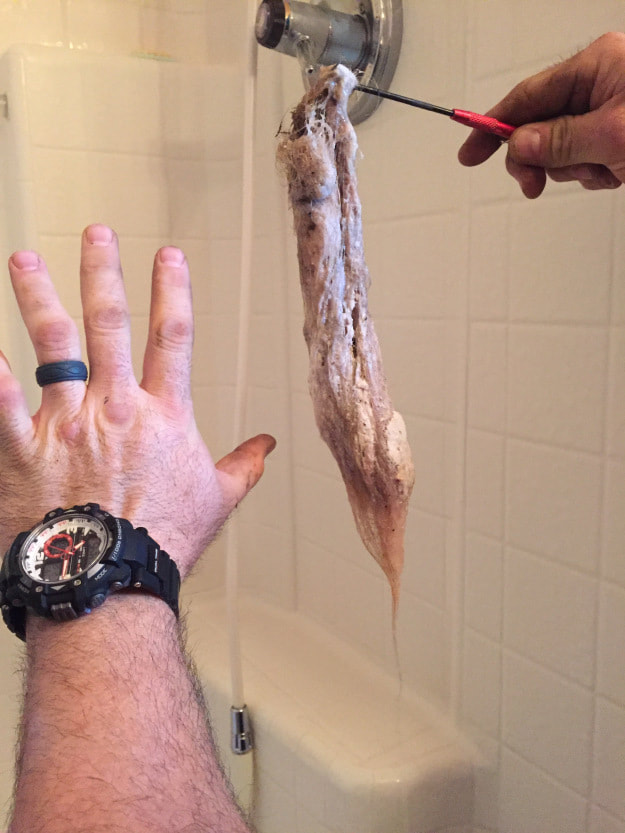
Hair volume in a shared bathroom is one of the most common drivers of repeat drain calls in high-occupancy rentals.
Cast Iron Doesn't Fail Gracefully Under Extra Load
Cast iron building drains, still common under Isla Vista's older apartment stock, fail from the inside out. Scale and mineral buildup accumulate on the interior wall over decades in a process called tuberculation, and it doesn't happen evenly. Water and waste wear the buildup unevenly, narrowing the effective bore and roughening the interior surface, so hair, grease, and paper snag on a rough patch instead of flowing through and out. A pipe that started life at a full 3-inch interior diameter can be functioning at well under half that after 50-plus years, and high-frequency use just means the rough spots see more traffic and clog faster. This is why the same unit can get its kitchen line snaked twice in one semester. The clog isn't a fluke; it's a narrowed, roughened pipe wall doing exactly what it's going to keep doing until the section gets relined or replaced. We cover the actual repair options, from hydro-jetting to a full pipe repair or reline, in more detail in our guide to repipe vs. repair.
A clog that keeps coming back after snaking is usually a symptom, not the problem. Cabling punches a hole through a blockage and buys a few weeks, but it doesn't clean the pipe wall the buildup is clinging to. If the same drain has needed clearing more than once in a year, the more honest fix is a hydro-jet cleaning, and a camera run if the line has never been scoped, rather than another cable pass.
Water Heaters Built for a Family, Running Like a Dorm
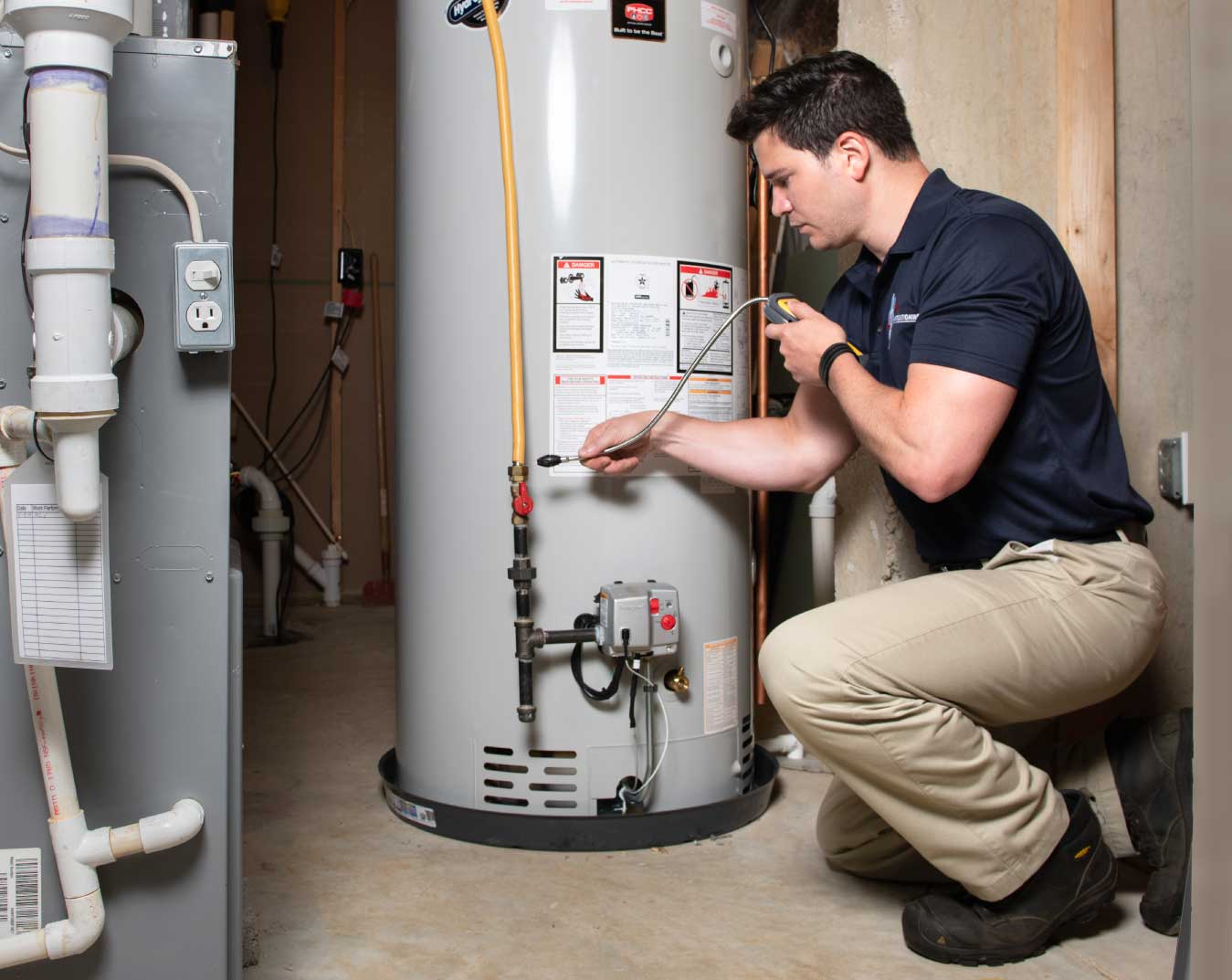
A 40-gallon tank water heater has a recovery rate, roughly how many gallons per hour it can reheat, that assumes staggered use across a day. In a five-person student rental where everyone showers between 7 and 8:30 a.m., that same tank runs through its stored hot water in the first two showers and spends the rest of the morning trying to recover against continuous draw. Tenants report it as "the water heater is broken." Most of the time it isn't broken; it's undersized for how the unit is actually being used, and it's also usually the original unit from whenever the building went up, well past the 8- to 12-year service life a tank heater typically gets even under normal residential use. Regional hard water doesn't help either; sediment collects faster at the bottom of a tank that's cycling harder, the same mechanism we cover in our hard water guide. When we're called to an I.V. property for "no hot water," replacing the tank with a properly sized unit, or in some buildings a tankless system that doesn't run out at all, usually solves the actual complaint instead of buying another year on a dying tank. Our water heater team sizes replacements to the household, not to whatever was already installed.
The Turnover Cycle Makes Everything Worse
Isla Vista runs almost entirely on a September lease cycle, which means most units get one real window for maintenance: the week or two between move-out and move-in. Landlords and property managers who don't use that window lose it for another year, because once new tenants are in, access gets harder and small problems get reported later than they should. We see the same failures show up every fall: a garbage disposal packed with grease and food scraps by a rotating cast of roommates over the year, a running toilet from a flapper nobody bothered to report, and a hairline leak under a sink that got worse over twelve months of nobody checking under there. None of these are expensive to fix individually. They get expensive when they're discovered by the incoming tenant instead of caught during turnover.
A Six-Unit Building's Annual September Surprise
A property manager calls every September with the same complaint from a different unit each time: a kitchen drain backing up in the first week after new tenants move in. Two prior years, a different company cabled the line and moved on. We ran a camera and found heavy grease buildup sitting on a section of cast iron with enough interior scale that it was functionally a 1.5-inch pipe pretending to be 3-inch. Hydro-jetting cleared buildup that cabling had been leaving behind for two years running, and switching the building to an annual jetting visit timed to the turnover window meant the following September's move-in went by without a single drain call from that address.
Illustrative example. Specific outcomes vary based on pipe material, age, and building conditions. Prior results do not guarantee similar outcomes.
What Actually Prevents the September Call
The properties that don't end up on our emergency list in the fall are the ones on a maintenance schedule instead of a reactive one. That typically means an annual or twice-yearly hydro-jet of building drain lines rather than waiting for a backup, a camera inspection of any cast iron or clay line that's never been scoped, water heaters sized to actual occupancy rather than replaced like-for-like when they fail, and a walkthrough during the turnover window specifically looking for slow leaks, running fixtures, and disposal units before a new tenant's boxes are sitting in front of them. Our preventative maintenance plans are built around exactly this: a scheduled visit that catches the small stuff before it becomes the emergency call at 11 p.m. on a Friday during week two of fall quarter. Our drain cleaning team handles the jetting side of that schedule, and it's a lot cheaper on an annual contract than as a one-off emergency dispatch.
| Common I.V. rental call | Usual root cause | What actually fixes it |
|---|---|---|
| Kitchen drain backs up repeatedly | Grease and interior scale buildup in aging cast iron | Hydro-jetting, camera inspection, reline if scale is severe |
| "The water heater is broken" | Tank sized for a family, running against student-schedule peak demand | Right-sized tank replacement or tankless conversion |
| Running toilet | Worn flapper or fill valve, unreported across a year of tenant turnover | Flapper/fill valve replacement, caught during turnover walkthrough |
| Recurring slow shower drain | Hair volume from high-occupancy bathroom use | Regular jetting, hair-catching strainers, scheduled service instead of snake-only response |
The Bottom Line
Isla Vista's plumbing problems aren't a mystery and they aren't the tenants' fault. They're what happens when housing built for one occupancy pattern in the 1960s and 70s keeps running at two to three times that load, decade after decade, with maintenance windows that only open once a year. Owners and property managers who treat the September turnover as a maintenance deadline instead of a moving day tend to stop seeing the same call from the same unit every fall.
If you manage property in Isla Vista, call us before the lease turns over and we'll walk the building with you, camera anything that's never been scoped, and set a maintenance schedule that actually matches how the plumbing is being used.