We get asked about tankless water heaters almost every week, usually right after a tank has failed and someone's standing in a wet garage wanting an answer fast. The honest answer is never a flat yes or no. Tankless units solve real problems, mainly standby energy loss and floor space, but they trade those for a different set of requirements around gas supply, venting, and maintenance that a tank never had to worry about. Here's what actually decides whether a tankless conversion makes sense for a given house in this county, in plain numbers rather than marketing language.
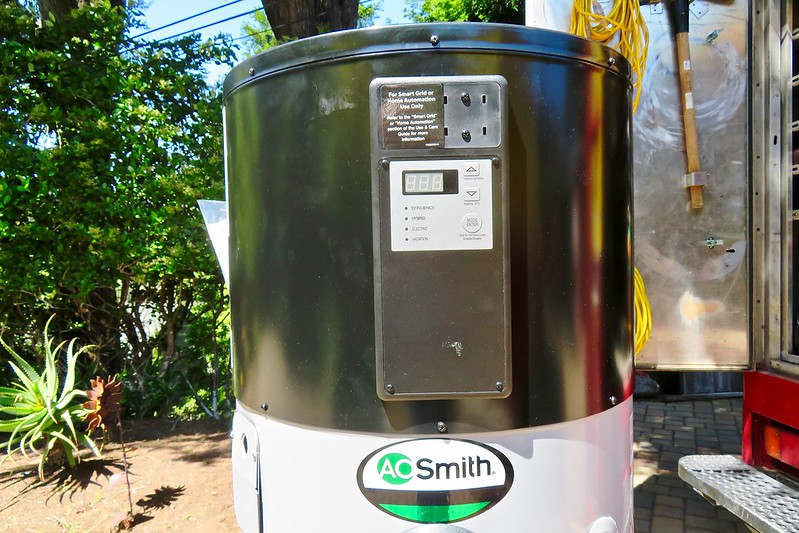
How a tankless unit is actually different, mechanically
A conventional tank keeps 40 to 50 gallons of water hot around the clock, cycling a burner on and off to hold temperature even when nobody's using hot water. That standby loss is real and it's the main inefficiency tankless eliminates. A tankless unit stores nothing. A flow sensor detects when a fixture opens, a modulating gas valve ignites and adjusts output to match demand, and water passes through a compact heat exchanger and comes out the other side at temperature, all in the few seconds it takes to travel from the cold inlet to the hot outlet. No storage means no standby loss, but it also means the unit's maximum output at any moment is fixed by its burner size and the temperature rise it has to produce, not by how much water happens to be sitting in a tank.
The sizing math most quotes skip
Every tankless spec sheet lists a maximum flow rate, and almost every homeowner reads that number as the number. It isn't, not on its own. Flow rate and temperature rise trade off directly: the bigger the temperature rise a unit has to produce, the less flow it can deliver at full output. Incoming water here typically runs somewhere in the high 50s to low 60s Fahrenheit, and a standard 120°F setpoint means the unit is producing something like a 60°F rise on every gallon. Manufacturers advertise their headline flow numbers at a much smaller rise, often 35°F, because that's what a colder-climate installation typically needs. A unit rated for 9 to 10 gallons per minute at that smaller rise might only deliver 4.5 to 5.5 gallons per minute once you account for Ventura's actual incoming temperature, and that gap is the single most common reason a new tankless system feels underpowered.
| Fixture | Typical draw |
|---|---|
| Showerhead | About 2.0 GPM (federal max-flow standard) |
| Kitchen faucet | Roughly 1.5–2.2 GPM |
| Dishwasher | Roughly 1–2 GPM |
| Washing machine | Roughly 2–2.5 GPM |
Run the math on two showers and a dishwasher at once, a realistic morning in a lot of households, and you're already asking for 5 to 6 GPM at a 60°F rise. That's within reach of a properly sized whole-house unit, but it's exactly the scenario where an undersized unit, or one sized off its 35°F-rise headline number, leaves someone with lukewarm water. We size every quote off the manufacturer's actual temperature-rise chart against our local incoming water temperature, not the number printed on the box.
Gas line and venting: the part that changes the price
A standard 40-gallon gas tank heater runs on roughly 40,000 Btu/h and is usually fine on the existing half-inch gas line. A whole-house tankless unit commonly draws 150,000 to 199,000 Btu/h, and that jump often means the existing gas line is undersized for the new unit once you account for the length of run and the number of fittings between the meter and the heater. Upsizing that line, sometimes to 3/4-inch or larger, is common enough that we check it during every tankless site visit rather than assuming the existing line will carry the load.
Venting is the other variable. Non-condensing tankless units need stainless steel venting with specific clearances to combustibles, routed through a wall or roof much like a traditional water heater flue. Condensing units vent with PVC, CPVC, or polypropylene instead, which is easier to route but produces mildly acidic condensate that needs a drain or a neutralizer kit. And because gas water heaters above 75,000 Btu/h fall under the county air district's low-NOx emission requirement, the unit itself has to be a certified low-NOx model, not just whatever's cheapest to source. None of this is a reason to avoid tankless. It's the reason a real quote requires a site visit rather than a number over the phone, and it's usually where a "simple swap" estimate and the actual invoice diverge if nobody checked beforehand.
Local water commonly runs 250 to 400 ppm. A tank's 40 to 50 gallons give scale somewhere to settle without immediately affecting performance. A tankless heat exchanger routes every gallon through passages a few millimeters wide, so the same mineral load narrows those passages faster and shows up as reduced flow, error codes, or efficiency loss well before a tank would show any symptom at all. Manufacturers spec a periodic descaling flush, circulating a mild acid solution through an isolation valve kit installed at the unit; in water this hard, we recommend doing that every 12 to 18 months rather than the 2 to 3 years some drier-climate installations get away with. Skip it and most manufacturers will deny a warranty claim on scale-related failure.
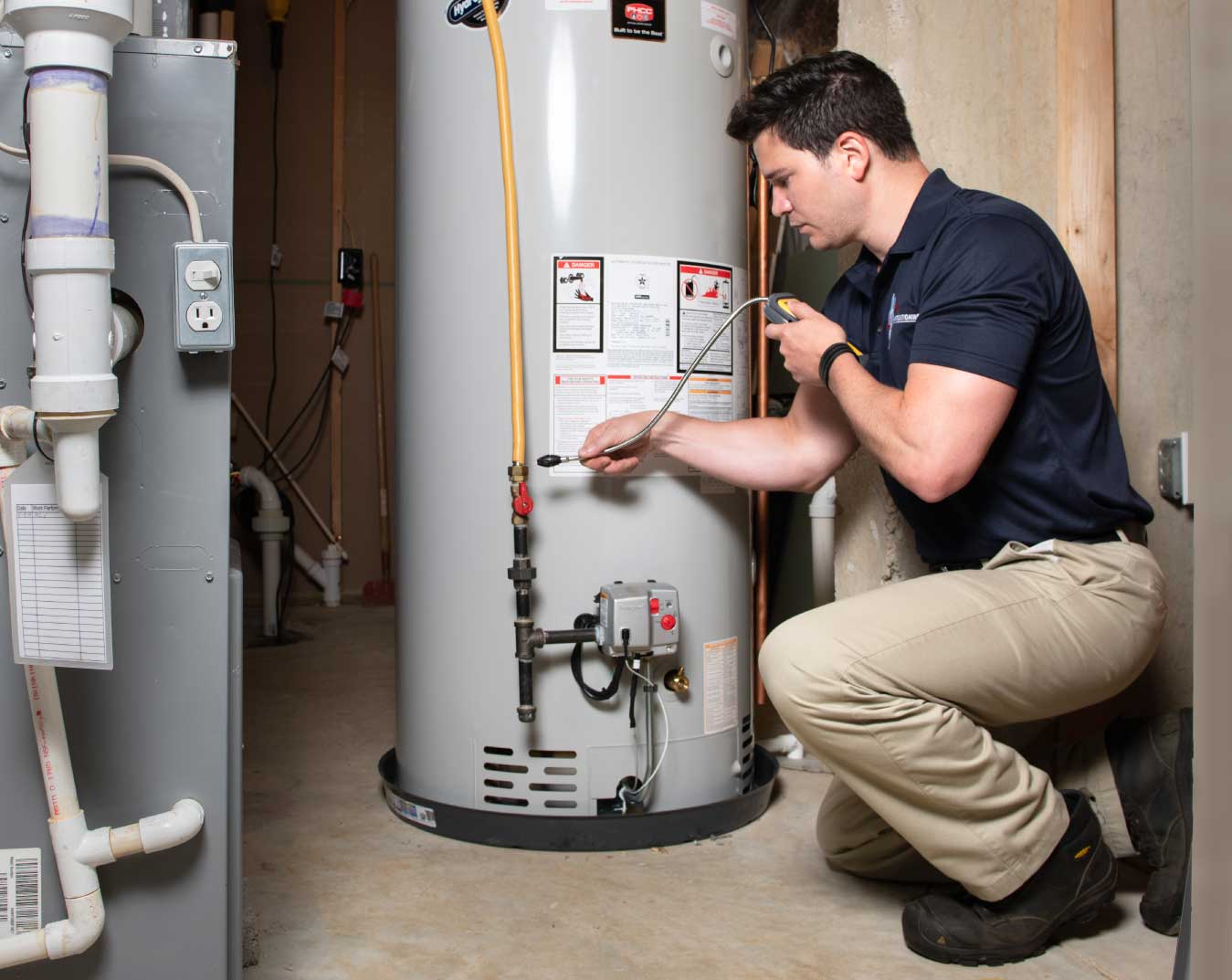
Confirming gas line sizing and venting is where most of a tankless conversion's real cost gets decided.
Where tankless actually earns its keep here
- Tight utility closets and garages. A wall-mounted unit frees floor space in the small mechanical closets common in older Midtown and downtown homes, which matters when that same closet is also holding a washer, dryer, and electrical panel.
- ADU conversions. A compact wall-mounted heater solves a real space constraint on a lot of accessory dwelling unit projects where floor area is already tight.
- Homes already mid-repipe. If a wall is already open for supply line work, adding a gas line upgrade or new vent penetration at the same time is a fraction of what it costs as a standalone job later.
- No seismic strapping requirement. California law requires tank water heaters to be double-strapped for seismic safety; a properly wall-mounted tankless unit doesn't carry that same requirement, one less thing to maintain.
- Larger households with genuinely spread-out demand. Bigger homes in areas like Thousand Oaks, where multiple bathrooms and a laundry room can all be in use across a longer window rather than all at once, are a good match for a unit's continuous, on-demand output.
Where a tank is still the smarter call
- An emergency same-day replacement. A tank swap can usually happen the same day. A tankless conversion that needs gas line or venting work often can't, simply because the parts and permit process take longer.
- Genuinely simultaneous high-demand households. A house that regularly runs three or four fixtures at once, rather than in sequence, may need a second unit or a larger service to avoid the same undersizing problem described above, which adds real cost.
- Electric-only homes without service capacity. Whole-house electric tankless commonly needs a 150 to 200 amp dedicated draw, which most existing panels can't supply without an upgrade. A point-of-use electric unit for a single remote fixture is a different, much simpler story.
A "simple swap" that needed the gas line and the vent both replaced
A homeowner in a 1940s bungalow near downtown wanted to convert a failing tank to tankless in a small hallway closet. The existing gas line was half-inch and had three fittings between the meter and the closet, undersized for a 199,000 Btu/h unit at that run length, and the old B-vent wasn't rated for the new unit's exhaust temperature. We caught both during the initial site visit, quoted the line upsizing and vent replacement up front, and the homeowner decided to move forward knowing the full number rather than getting a change order mid-installation. The unit's been running three years without a callback since, on a 12-month descale schedule.
Illustrative example. Specific outcomes vary based on existing infrastructure and site conditions. Prior results do not guarantee similar outcomes.
What it costs, in real ranges
| Scope of work | Typical installed cost | What drives the range |
|---|---|---|
| Tank-for-tank replacement | $1,500–$3,000 | Unit size and whether existing connections and strapping are reused as-is |
| Tankless conversion, gas line and venting already adequate | $3,500–$5,000 | Unit cost, mounting, and standard hookup |
| Tankless conversion, gas line and/or venting upgrade required | $5,500–$7,500+ | Line upsizing, new vent routing, and any wall or closet modification |
| Descaling maintenance flush | $150–$300 per visit | Recommended every 12–18 months in local water conditions |
A properly maintained tankless unit commonly lasts around 20 years against roughly 10 to 12 for a tank, which is the other side of the cost comparison worth factoring in over the long run. We build a preventative maintenance plan around the descaling schedule for every tankless install we do, because the unit's actual lifespan depends on it far more than a tank's ever did.
The bottom line
Tankless isn't a universal upgrade and it isn't a gimmick either. It's a different piece of equipment with different requirements, and it performs well in this county specifically when someone sizes it off real temperature-rise numbers, checks the gas line and venting before quoting a price, and keeps it on a descaling schedule that matches our water instead of a national average. Get those three things right and a tankless conversion holds up. Skip any one of them and it becomes the "we went tankless and regretted it" story we hear from homeowners who bought the unit somewhere else.
Call us before you decide either way. We'll size it against your actual fixtures, check what your gas line and venting can support, and give you a number that won't change once the wall's open.