Most homeowners never think about their sewer lateral until it backs up, and even then, the conversation with a plumber usually starts the same way: "we don't actually know what's wrong until we look." A sewer camera inspection is that look. It's a self-leveling color camera on a flexible push-rod, fed down through a cleanout or a fixture drain, that shows us exactly what condition the pipe is in for its entire run to the city main, no digging required to see it.
We run these constantly across the county, and what the camera finds is rarely random. It's a pretty direct function of when a house was built and what material its lateral was plumbed in, because Ventura County's housing stock spans nearly a century of very different sewer pipe standards. Here's what we actually see down there, why roots and time eventually win no matter how well a pipe was installed, and what the repair options look like once we know what we're working with.
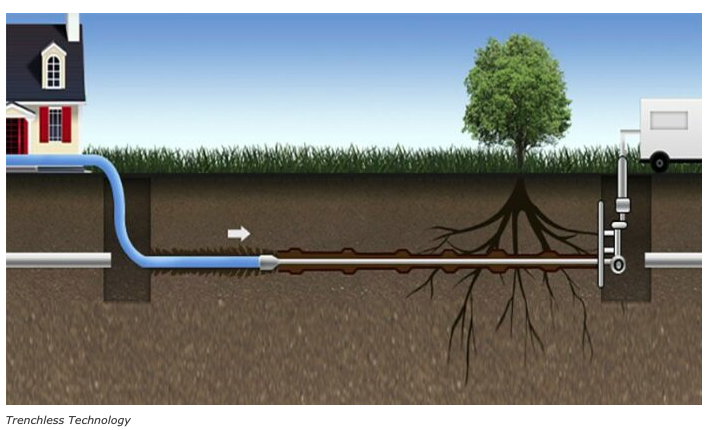
What a camera inspection actually shows
The camera head has its own light and typically a footage counter, so as it travels we know both what we're looking at and precisely how many feet from the cleanout it is. On a well-run inspection, we're identifying and logging: root intrusion at joints, cracks and fractures, offset or separated joints, "bellies" (low spots where the pipe has sagged and now holds standing water and solids between uses), corrosion and scaling, and any full blockage. For jobs where the exact location matters, like before excavation, we run a sonde, a small radio transmitter built into the camera head, and trace its position from the surface with a locator wand, which gets us within roughly an inch of the pipe's actual depth and position without any exploratory digging.
This is also the step that turns a repair estimate from a guess into a plan. A sewer line inspection tells us whether we're looking at a five-minute root cut, a section that needs relining, or a full collapse that needs to be dug up, and that distinction is the difference between a $300 job and a $10,000 one. We'd rather spend thirty minutes with a camera confirming which one it is than guess.
The pipe materials still in the ground across the county
What the camera finds depends heavily on the decade a neighborhood went in. Ventura County grew in real waves, and each wave built with whatever the plumbing code and supply chain of that era favored.
| Material | Common era | How it fails | What we typically find |
|---|---|---|---|
| Vitrified clay (VCP) | Pre-1960s | Rigid pipe with mortared or hub joints that shift over decades, creating gaps roots exploit | Root intrusion concentrated exactly at the joints, sometimes with joint offset from soil movement |
| Orangeburg (bituminous fiber) | Mid-1940s–early 1970s | A tar-impregnated wood-pulp pipe that absorbs groundwater over time and loses rigidity | Ovaling, blistering, and delamination rather than a clean crack, sometimes visible as the pipe wall flaking off in the camera view |
| Cast iron | 1950s–1970s (mainly indoor runs) | Internal scaling that narrows the bore and eventually corrodes through | Rough, tuberculated interior walls and reduced flow diameter |
| ABS / PVC | 1970s–present | Rarely fails on its own; problems are usually at fittings or from external damage | Generally clean lines, with occasional grease buildup or a fitting installed off-grade |
The pipe most people have never heard of is often the one causing the problem. Orangeburg pipe was installed nationwide, including large parts of Ventura County, during the postwar building boom because copper and cast iron were expensive and harder to source. It was rated for roughly 50 years of service. Any home built in that window still running its original lateral is now decades past that design life, and Orangeburg doesn't fail with a clean crack the way clay or cast iron does, it deforms, flattens, and delaminates from the inside, which is exactly the kind of damage a visual inspection catches well before it becomes a full collapse.
How roots actually get in, and why they eventually win
Roots don't punch through solid pipe. They find an existing weakness, a joint gap, a hairline crack, a soft spot in aging Orangeburg, and grow toward it because the pipe is a steady source of moisture and nutrients, especially nitrogen-rich wastewater. Once a root tip is inside, it doesn't stop; it branches into a dense mat that catches paper and grease, and it keeps expanding in diameter as the tree itself grows, which can widen the original crack it entered through. This is why root intrusion is a progressive problem rather than a one-time event. Clearing the roots out of a line doesn't change the joint gap that let them in, which is why the same root ball tends to come back within a year or two if the underlying opening is never actually repaired.
Mature street trees, ficus and pepper trees especially, are common across the county's older neighborhoods, and they sit directly over decades-old clay or Orangeburg laterals in a lot of the housing built around Santa Paula and the older tracts of Oxnard. That combination, an aging pipe material with joints that were never designed to be watertight forever, sitting under mature root systems actively seeking moisture, is close to the single most common sewer call we get.
A "clog that keeps coming back" turns out to be a joint, not a clog
A homeowner has had their line cabled twice in eighteen months by a different company, each time getting a few months of relief before the same slow backup returns. We run a camera and find a single offset joint about 40 feet out, with a root mass that has regrown to nearly the same size both times it was cut. Cabling was clearing the immediate blockage but never touching the actual opening the roots were using. A short section of cured-in-place lining across that one joint solves the root access problem instead of just the symptom, and eighteen months later the same section has stayed clear.
Illustrative example. Specific outcomes vary based on pipe material, age, and site conditions. Prior results do not guarantee similar outcomes.
What we do once we know what's down there
The repair matches what the camera actually found, not a one-size-fits-all response.
- Hydro-jetting: a hose with rotating nozzles that sprays water at pressures up to roughly 4,000 psi, scouring the full diameter of the pipe clean of roots, grease, and scale. This is the standard prep step before lining a pipe, and it does a more complete job than cabling alone.
- Cabling: a spinning cutting head that punches through a blockage. Faster and cheaper for an immediate clog, but it doesn't clean the full pipe wall the way jetting does.
- Cured-in-place pipe (CIPP) lining: a resin-saturated felt liner is pulled or inverted into the cleaned pipe, then cured in place (with heat, UV light, or ambient cure depending on the resin) to form a new, jointless pipe inside the old one. This is trenchless, and it's the go-to for a structurally sound pipe with joint or root problems rather than a full collapse.
- Pipe bursting: a bursting head is winched through the old pipe, fracturing it outward into the surrounding soil while pulling new HDPE pipe in behind it in the same pass. Trenchless, but it requires small access pits at each end rather than the continuous trench of a traditional dig.
- Open-trench replacement: still the right call when a section has already collapsed, bellied severely, or lost so much material that nothing can bond to it or travel through it.
New sewer lateral installation in California is required to maintain a minimum slope of about 1/4 inch of fall per foot of run, steep enough for waste to flow by gravity without letting solids settle out. A bellied section that has lost that slope is one of the more common findings that pushes a repair from a lining candidate to a dig, because you can't line a low spot back into having proper fall.
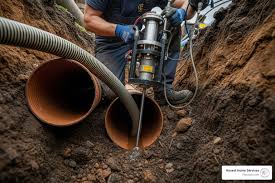
A liner sleeve staged for a section that needed a short trenched repair rather than a full lining run.
What it costs, in real ranges
| Scope of work | Typical cost | What it addresses |
|---|---|---|
| Camera inspection | $200–$400 | Full diagnostic look at the lateral's condition and exact problem locations |
| Spot repair or root clearing | $500–$2,000 | A single damaged section, joint repair, or hydro-jet cleaning |
| Trenchless lining or bursting | Generally comparable to, and sometimes below, full open-trench replacement | Rehabilitating or replacing a structurally sound but failing pipe with minimal excavation |
| Open-trench replacement | $3,000–$15,000+ | Full excavation and replacement, typically for collapsed or severely bellied sections |
We always run the camera first and quote off what it actually shows rather than a flat number, because the range between a root cut and a full replacement is wide enough that a real diagnosis is the only way to give you an honest figure. Our drain cleaning team handles the jetting and cabling side of this; anything that needs lining, bursting, or excavation gets scoped and quoted as sewer line work.
When to get a camera run even if nothing's backing up yet
A few situations are worth getting ahead of rather than waiting for a backup: a home over about 50 years old that has never had its lateral scoped, a property with mature trees directly over the sewer line's known path, a recurring slow drain that clears and returns, and a home purchase or sale, since a lateral in poor condition is exactly the kind of five-figure surprise a buyer wants to know about before closing rather than after. None of these require a decision to dig anything up. They just require a look.
The bottom line
A sewer camera inspection turns a guess into a diagnosis, and the diagnosis is almost always tied to two things: what the pipe is made of, and how long roots have had access to it. Vitrified clay and Orangeburg laterals installed decades ago across the county's older neighborhoods are simply on borrowed time by design, not because anyone installed them poorly. If your home falls into that category, or you've had the same backup cabled more than once, get the camera run before the next call is an emergency instead of a scheduled visit.
Call us and we'll run the camera, show you what we find, and walk you through exactly what it means before recommending anything.